

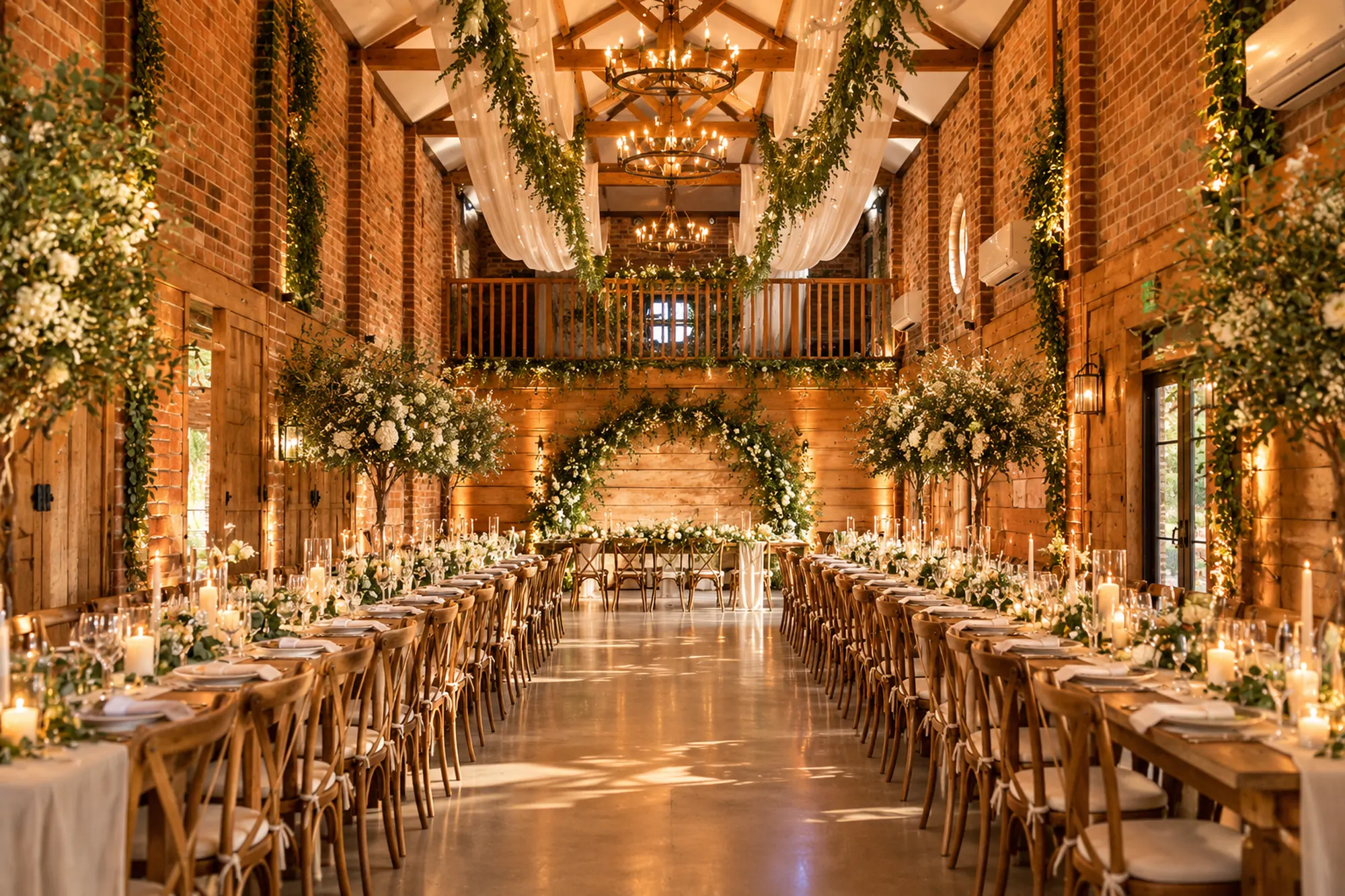
Shropshire weddings tend to happen somewhere quiet: a Georgian house at the end of a long drive, a castle in its own parkland, or a centuries-old barn on a working farm. That peace and quiet is part of the appeal, and it is also why some venues ask bands to keep an eye on the volume.
A sound limiter or a noise limit rarely rules out a live band. Here is what they are, why Shropshire venues use them, and what to ask before you sign anything.
01What is a sound limiter?
A sound limiter is a meter, usually mounted on a wall, that keeps track of how loud the music in the room is. The venue chooses the maximum. As long as the music stays below it, nothing happens. If the level goes over for more than a few seconds, the limiter turns off the electricity to the band or DJ.
Most show the level with coloured lights:
When it trips, the speakers, lights and amps all go off together. Some come back on by themselves after a short wait. Others need someone from the venue to reset them. Not every venue uses a limiter, either: some simply set a noise limit in decibels and ask the band to stay under it.
02Why do Shropshire venues use them?
Most of the reasons come back to the countryside. On a still night, music carries a long way across open fields, and a few nearby houses or a village can be enough for a venue to have noise conditions on its licence.
- Listed houses. Grade I and Grade II listed homes like Hawkstone Hall and Davenport House have historic interiors to protect and often guests sleeping upstairs. Davenport House, for example, sets a noise limit for live bands.
- Castles and hotels. At Rowton Castle, the band plays in a set room and finishes at a set time, with the DJ carrying on after. Timings like these matter as much as the volume.
- Farm barns. Venues like Burlton Manor, Pimhill Barn and Delbury Hall sit in working countryside, where the rules depend on the building and the neighbours.
- Marquees. A marquee on the lawn lets far more sound out than a stone or brick building, so estates often have rules for them.
Every venue is different. Some have no limit at all, and plenty that do set it at a level a good band can play to. It is always worth asking.
03Does it matter for a live band?
Yes, more than for a DJ. A DJ can bring the whole room down with one fader. A band has acoustic instruments that are loud before any amplification: a drum kit, a trumpet and a saxophone are all loud on their own, so a live band has a natural minimum volume.
Faced with a sensible limit, a good wedding band will:
- balance the sound for the room, aiming for clarity rather than sheer volume
- use in-ear monitors so the stage itself stays quieter
- swap to an electronic drum kit where the limit is tight
- set up well away from the limiter's microphone if the room allows, and keep watching the lights
When a limit is close to background-music level, though, a full band will struggle. For rooms like that, these are worth a look:
04Questions to ask your venue
Ask these at your viewing, or email them to the coordinator. Then pass the answers on to your band:
- Is there a limiter or a noise limit?Some venues use a limiter, others just give bands a figure to stay under. Find out which.
- What is the figure in decibels?And ask whether it drops later in the night.
- Which room does the band play in?Some venues put the band in a particular room, which may have different rules from the rest of the house.
- What happens if it trips?Find out whether the power comes back automatically, and how long that takes.
- Where is the microphone?The further it is from the band, the easier it is to stay under the limit.
- What time does the music stop?Some venues have one finish time for a band and a later one for a DJ.
A band that plays weddings week in, week out should be able to tell you straight away whether those answers work.
05What we do
We are a 9-piece wedding band in Shropshire with a live horn section, playing soul, funk, R&B, Motown and pop. We have played rooms with tight limits and rooms with their own house PA, and our professional sound technicians look after our levels all night.
Our rule of thumbA limit of around 100 decibels, with the limiter at least 7 metres from the stage, lets our full 9-piece play at its best.
If your venue's figure is lower, talk to us. We have played plenty of quieter rooms using in-ear monitors and an electronic drum kit, and we will tell you honestly what is possible.
The simplest thing you can do is ask the question before you book. Get the figure from your venue, send it to us, and you will get a straight answer, long before your first dance.
06Quick answers
Will a noise limit stop us having a band?
Rarely. Around 100 decibels, with the limiter at least 7 metres from the stage, lets our full 9-piece play at its best, and we have played quieter venues using in-ear monitors and an electronic drum kit. Ask your venue for the figure and send it to us before you book.
What is the difference between a limiter and a noise limit?
A limiter is a device that cuts the power if the music goes too loud. A noise limit is a figure the venue asks the band to stay under, without a cut-off. Either way, we set our levels to match.
Should we book a DJ instead?
Only if the limit is very low. Most couples have the band for the main sets and our DJ booth to keep the dancefloor going after, which also helps when the band has an earlier finish time than the DJ.