

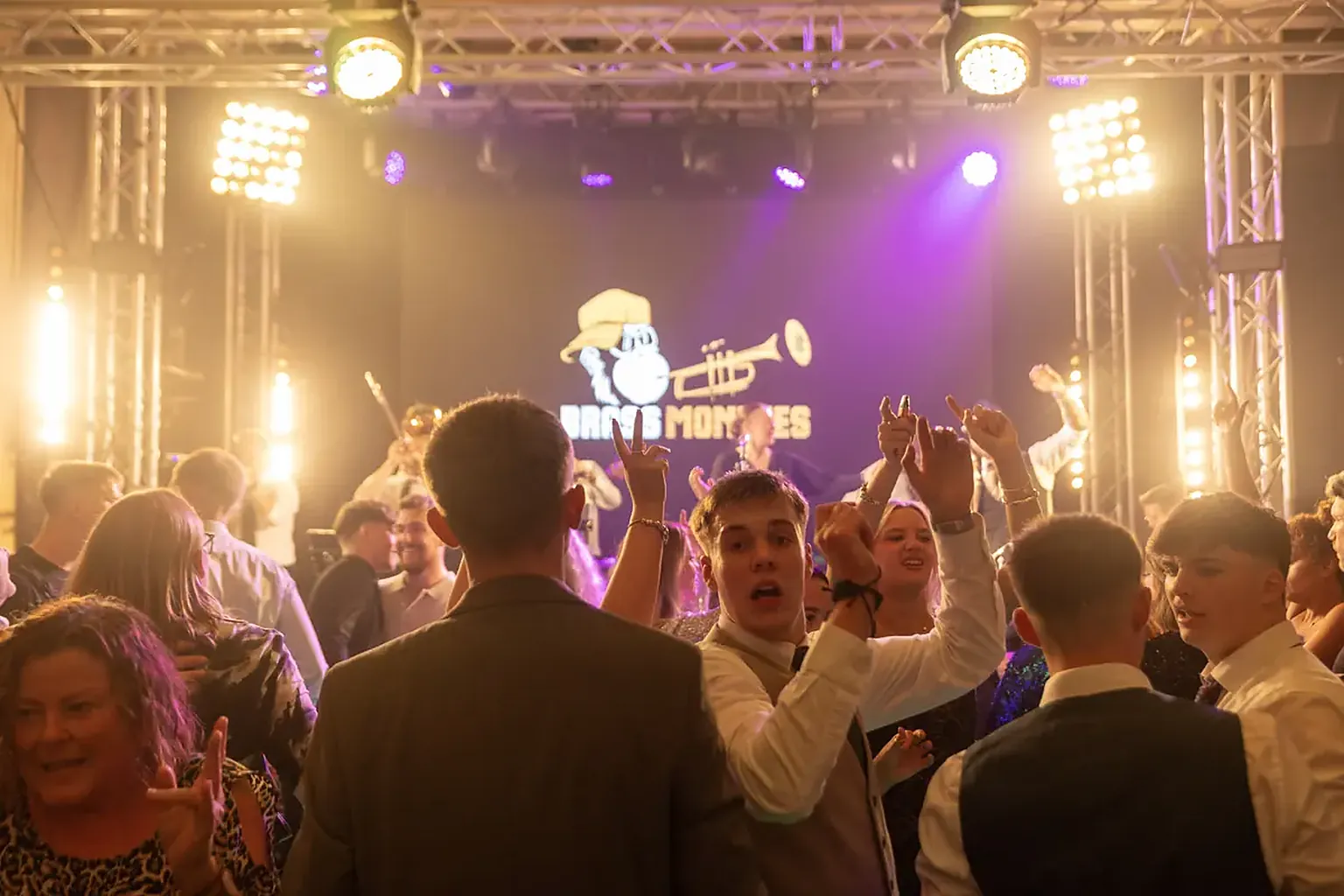
If you’re the one organising the staff party, the awards dinner or the client event, the sound limiter usually hides in the small print: one line in the venue’s event pack saying amplified music must stay under a set level. It’s easy to skim past, and it’s the detail that decides whether a live band will work in that room.
This guide is written for event organisers, PAs and HR teams. It covers where to find the limit, why hotels and conference venues have them, how to plan your running order around one, and exactly what to send your band. Planning a wedding instead? Our guide to sound limiters at wedding venues is the one for you.
01Find the limit in the venue’s paperwork
Venues rarely lead with it. Look in the event pack, contract or technical specification for words like noise management, amplified music or entertainment policy. If nothing’s written down, ask the events or AV team directly. Here’s what the usual wording means:
- dB or dB(A): the decibel level the limiter is set to. This is the number that matters most.
- “Averaged over 5 or 15 minutes”: the limit is measured as an average rather than every single loud moment, which is far kinder to a live band than an instant cut-off.
- Cut-off or trip: if the level stays over the limit, the power to the stage sockets switches off, taking the PA and lights with it.
- “Amplified music to finish by…”: a curfew, separate from the limiter. Check it against the time you want the party to end.
02Why hotels and conference venues have them
Most limiters are a licensing condition. A hotel has guests sleeping above the function suite, a conference centre may share a wall with offices or flats, and a city-centre venue has neighbours on every side.
The reason organisers often don’t expect is other events. Big hotels and venues run several functions at once, especially in December, and the limiter stops one Christmas party drowning out the awards dinner on the other side of a partition wall.
A limit is a number to plan around, not a reason to cancel the band.
03Plan the night around the limit
The good news for corporate events is that most of the evening sits comfortably under any limit. Arrival drinks, dinner, speeches and award presentations are quiet by nature. It’s the last couple of hours, when the dance floor fills, that need the headroom.
So ask the venue one extra question: does the limit change during the night? Some lower it after 11pm, and many set it higher in the main ballroom than in a smaller suite. Then build your running order around it: roaming brass to greet guests, background music through dinner, and the band’s full sets once the formalities are over.
The number we look forAround 100 decibels, with the limiter’s microphone at least 7 metres from the stage, lets our full 9-piece play at its best.
A tighter limit can still work with in-ear monitors and an electronic drum kit. Send us the figure and we’ll tell you straight.
04What to send your band
Put these in one email to the band before you sign anything, and you’ll avoid nearly every surprise on the night:
- The limit and how it’s measuredThe decibel figure, whether it’s an average or an instant cut-off, and any change through the night.
- Where the limiter’s microphone sitsA photo or a floor plan with the stage area marked is perfect.
- The room and the numbersWhich suite you’re in, how many guests, and whether other events are on that night.
- Access and timingsThe load-in route, any lifts, parking for vans, and when the room is free to set up and soundcheck before guests arrive.
- PowerTwo separate 13 amp supplies on individual spurs near the stage, or a 32 amp generator supply with 13 amp sockets for the band’s sole use if it’s a marquee.
- Who to call on the nightThe duty manager or AV technician who can reset the limiter if it ever trips.
Venues often ask organisers for the band’s public liability insurance and PAT certificates too. We send ours over as standard, so that’s one less thing to chase.
05In-house AV and shared rooms
- In-house PA: some conference venues prefer bands to plug into their own sound system. We’re happy to, and we’ll talk to their AV team beforehand about inputs and levels.
- Partition walls: if your suite is divided from another event by a movable wall, expect a stricter limit. Ask what’s booked next door.
- Lighting and haze: our setup includes stage lighting, but some venues have rules about haze near smoke detectors, so check before the day.
- Marquees and outdoor events: noise conditions can apply here too, alongside the generator, so ask the site or event supplier early.
06If the limit is too tight
If the figure is too low for a full band, you can still give guests live music where it counts:
07How we work at corporate events
Awards dinners, Christmas parties, conference evenings and client celebrations: we’ve played hotel ballrooms, conference centres and marquees with every kind of noise rule. Our own sound technician watches the limiter’s lights all night and adjusts the mix long before it gets close to tripping, so you can get on with hosting.
Send us the venue’s figure when you enquire and we’ll tell you honestly whether it will work. You’ll find more about our function band for corporate events, and answers to common questions in our FAQs.
We play corporate events and parties across Cheshire, Liverpool, Manchester, Shropshire, Staffordshire and North Wales.
08Quick answers
Do hotels and conference venues have sound limiters?
Many do, especially hotels with bedrooms above the function suite and venues close to homes or offices. It's usually in the event pack or technical specification. If it isn't written down, ask the events team directly.
Will a sound limiter affect speeches and awards?
Rarely. Speeches, presentations and background music sit well below most limits. It's the party later in the evening that needs the headroom, so that's the level to check.
Can your band plug into the venue's own PA?
Yes. We're happy to use an in-house sound system, and we'll speak to the venue's AV team beforehand about inputs and levels.
What if another event is in the room next door?
Expect a stricter limit when rooms are divided by a partition wall. Ask the venue what else is booked that night and tell us, so we can plan the levels from the start.